

Digital Transformation in Saudi Arabia
The digital transformation in the Kingdom of Saudi Arabia is witnessing a qualitative leap and unprecedented acceleration, driven primarily by the ambitious Vision 2030, which aims to build a prosperous digital economy and a vibrant society. National initiatives focus on several key axes: digitizing government services, stimulating innovation in the private sector, enabling advanced digital infrastructure, and enhancing human capabilities in advanced technology fields. Unified government platforms and digital identity have become prominent examples of developments that directly improve the quality of life for citizens and residents on a daily basis.
Digital Government and Facilitating Services
Digital government seeks to provide integrated, easy-to-use services available around the clock, which reduces the need to visit traditional headquarters and improves the beneficiaries’ experience. This approach contributes to increasing the efficiency of government spending and significantly reducing the time to complete transactions. Integration between different government entities is also enhanced through secure data exchange and shared application programming interfaces, ensuring the provision of seamless and interconnected services.

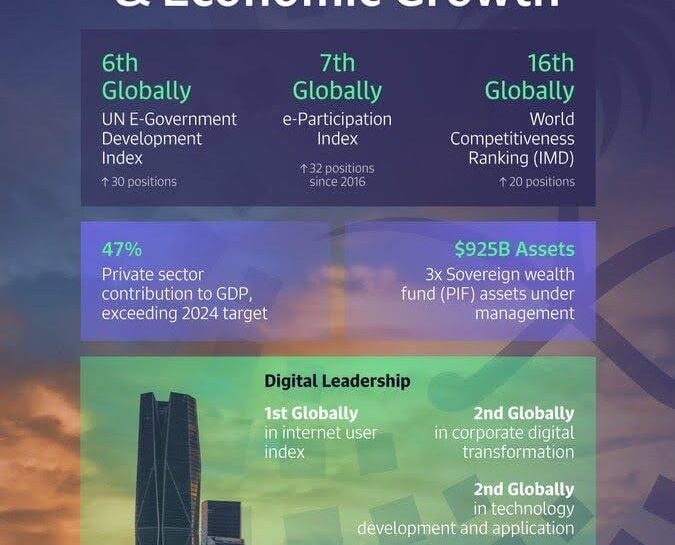
Infographic linking Vision 2030 to digital transformation pillars
Protecting Digital Infrastructure
With the increasing reliance on critical digital services, cybersecurity and business continuity play a crucial role in protecting these platforms and ensuring their reliability. National initiatives and standards have been launched to protect digital infrastructure and personal and government data, and digital risk management is considered an integral part of transformation strategies in all sectors.
The Role of the Private Sector and Enabling Innovation
In the private sector, digital transformation includes adopting cloud solutions, expanding the scope of e-commerce, and using data analytics and artificial intelligence to improve efficiency and innovation. Initiatives are widespread to enable small and medium-sized enterprises to benefit from digital technologies and enhance their competitive presence in the market. There is also heavy investment in communications infrastructure, such as 5G networks, to support advanced applications and the Internet of Things (IoT).
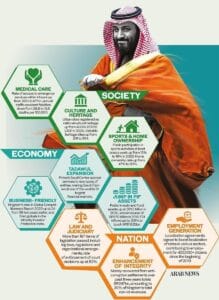
A map of the Kingdom with icons for multiple digital services
Building Digital Human Capacities
Building human capacities forms a fundamental axis to ensure the sustainability of the transformation, through training and qualification programs in the fields of software development, data sciences, and cybersecurity. These efforts are linked to an integrated system of universities, academies, and national initiatives to develop digital skills, which creates an integrated digital environment that supports innovation, entrepreneurship, and increases the competitiveness of the national economy.