

ISO 27001 Requirements
ISO/IEC 27001 is the globally recognized standard for establishing, implementing, maintaining, and continually improving an Information Security Management System (ISMS) across organizations of all sizes and sectors. The standard emphasizes risk management and the implementation of appropriate security controls to safeguard the confidentiality, integrity, and availability of information, thereby enhancing the confidence of customers, partners, and regulatory bodies.
Core System Requirements
The standard first requires organizations to define their context, including internal and external factors, interested parties, and their security requirements. Next, the scope of the ISMS must be clearly delineated—whether it encompasses the entire organization or a specific part of it. Top management plays a pivotal role by adopting a clear information security policy, providing necessary resources, and demonstrating ongoing commitment to the ISMS.
Risk assessment is a fundamental step in the process. It involves identifying information assets, threats, and vulnerabilities, as well as assessing the likelihood and potential impact of security risks. Based on this assessment, suitable security controls are selected from Annex A of the standard and documented in a Statement of Applicability (SoA).
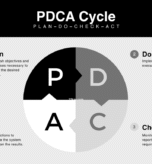
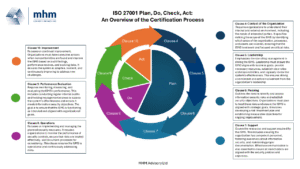
Infographic illustrating the Information Security Management System (ISMS) cycle (Plan-Do-Check-Improve)
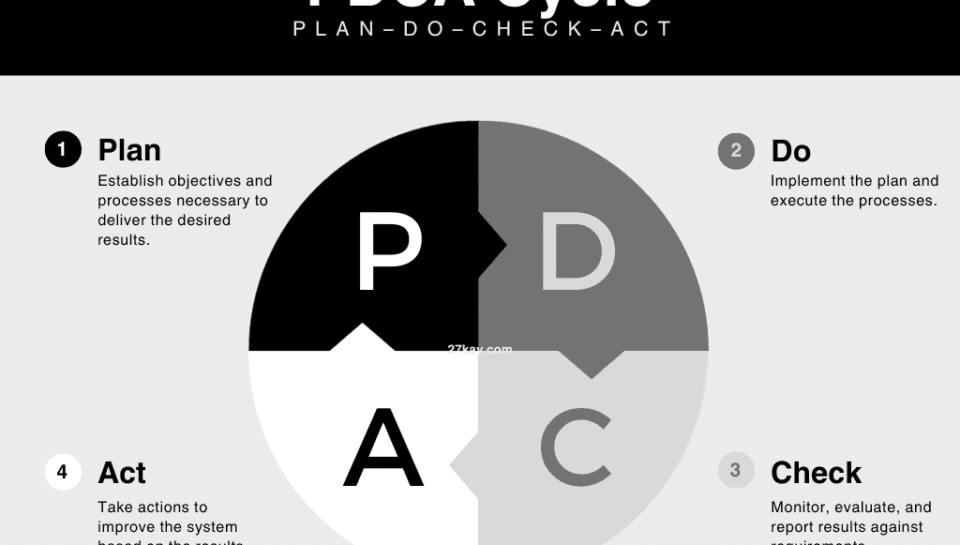
The Plan-Do-Check-Act (PDCA) Continuous Improvement Cycle
ISO/IEC 27001 implementation is based on the Plan-Do-Check-Act (PDCA) continuous improvement methodology to ensure the ISMS remains suitable, effective, and aligned with evolving business and security needs:
- Plan: Establish the information security policy, define the ISMS scope, conduct a risk assessment, and select appropriate security controls.
- Do: Implement the selected controls, document procedures, and provide staff training to ensure effective execution.
- Check: Perform regular internal audits, management reviews, and monitor the ISMS performance to evaluate its effectiveness.
- Act: Take corrective actions and drive continual improvements based on the findings from audits and reviews.
The standard also requires organizations to formally document their procedures and ensure their practical application through ongoing training and internal communication.
Checklist next to the ISO 27001 certification code
Certification and Sustainability
To obtain ISO/IEC 27001 certification, an organization undergoes an external audit conducted by an independent accredited certification body to verify compliance with the standard’s requirements. Once certified, the organization is subject to annual surveillance audits to ensure ongoing adherence to the standard.
Integrating ISO/IEC 27001 with other management systems—such as quality management (ISO 9001) or business continuity management (ISO 22301)—is a common practice. Such integration enhances organizational efficiency by aligning policies, processes, and controls across multiple frameworks, leading to more cohesive and effective enterprise governance.